
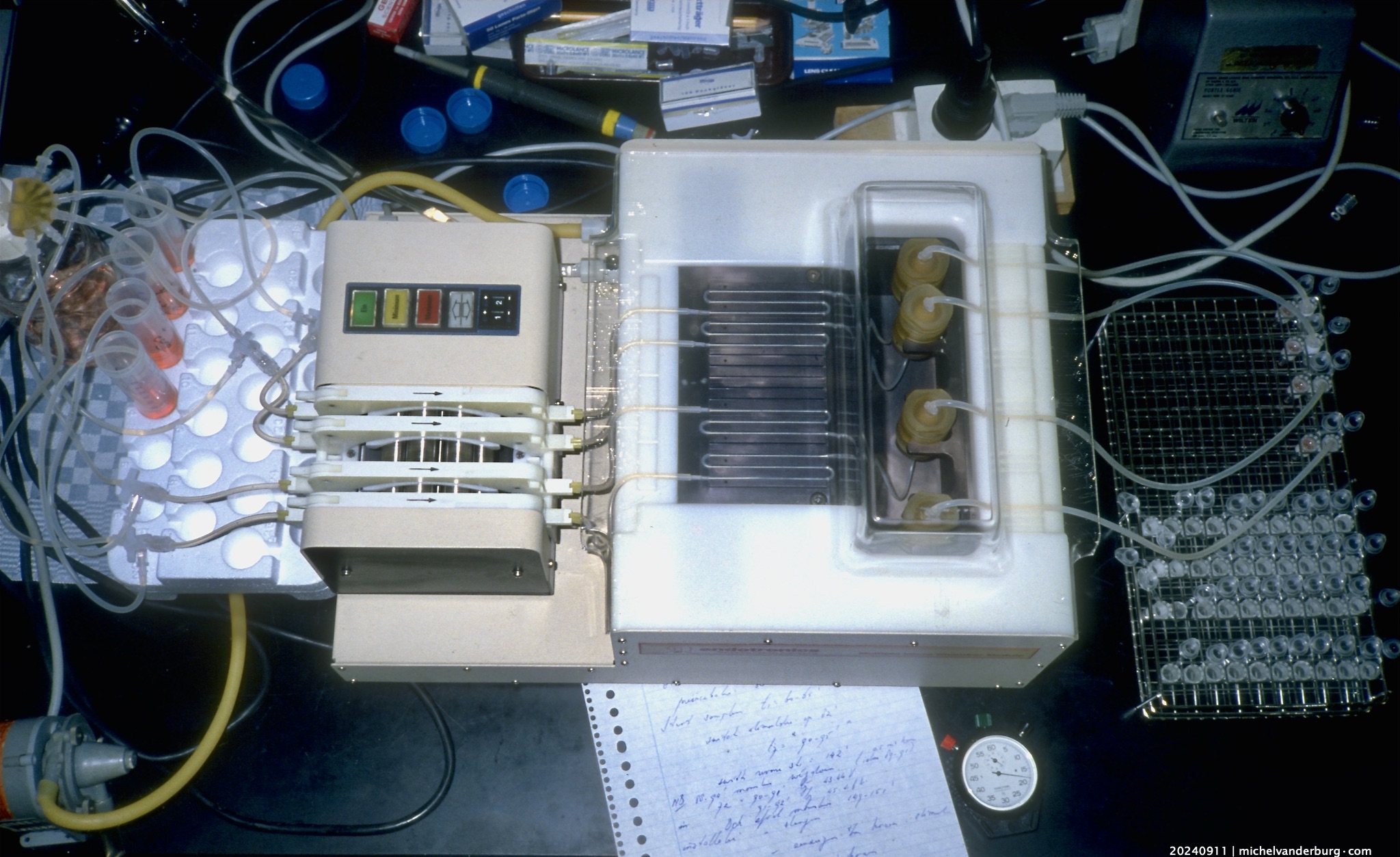
Perifusion system using the Acusyst-S in the Islet Transplant Lab started in 1987 in the University Hospital Leiden.
In this ‘perifusion’ device (6), the timeline of insulin secretion by the isolated islets is monitored in the laboratory.
Under the transparent cover, on the right side, hang 4 brown cylindrical plastic chambers (inside volume of 0.5 ml). In each of those chambers is the same portion of the isolated islets, with on average a total number of 453 islets, calculated as IEQ (4,5).
The test fluid – a simple salt solution containing glucose and, for example, gut hormones – flows via a small connecting tube from below into the chamber, where it flows around the islets (that’s why it’s called ‘peri’ fusion) and captures the sereted insulin, then exits the chamber from the top through an outlet tube into a cup in the rows of the collection cups on the rack on the right. Every 5 minutes, the outlet tube is manually moved to the next cup. Later, the amount of insulin in those cups is measured.
To the left of the block with the 4 chambers is the roller pump that pumps the various test fluids from the supply on the left in plastic tubes and bottles. The flow is switched using taps in those tubes.
Between the roller pump and the chambers, thin tubes run in loops over the black-metal heating block, which heats the fluids in the tubes and also keeps the entire space under the transparent cover at body temperature.
Incidentally, the walls of these thin tubes are gas-permeable, and the entire space under the cover is continuously ventilated with medical-grade air.
A maximum of 6 chambers can be used simultaneously, allowing up to 3 different tests to be conducted in parallel in duplicate.
Perifusion pilots had started in 1987 (1) in our Islet Transplant Lab of the University Hospital Leiden, and were followed in 1988, with large scale perifusion studies with isolated islets in our new project (more on this project here soon), in which the insulin secretion of isolated islets in perifusion experiments (in vitro) was compared with the function of the isolated islets after transplantation and also in concommitant pancreas transplantation experiments (in vivo), in support of the Leiden clinical pancreas transplantation program.
Some posters of this perifusion work have recently been posted online (2,3).
The scientific description of materials & methods of the perifusion work has been published in chapter 6 of the 1994 dissertation Pancreatic islet transplantation (4) and the similar paper (5).
Notes
1. Cradle of Islet Transplants • 20240829 • Michel van der Burg • michelvanderburg•com | URL https://michelvanderburg.com/2024/08/29/cradle-of-islet-transplants-20240829/
2. Gut factors controlling pancreatic islets • 20240910 | Michel van der Burg | michelvanderburg•com | URL https://michelvanderburg.com/2024/09/10/gut-factors-controlling-pancreatic-islets-20240910/
3. Gut feelings of pancreatic islets • 20240906 | Michel van der Burg | michelvanderburg•com | URL https://michelvanderburg.com/2024/09/06/gut-feelings-of-pancreatic-islets-20240906/
4. Pancreatic islet transplantation Thesis Repository Leiden University | 20221125 | Michel van der Burg | Miracles•Media | URL https://michelvanderburg.com/2022/11/25/pancreatic-islet-transplantation-thesis-repository-leiden-university-20221125/
5. Van der Burg MPM, Guicherit OR, Frölich M, Gooszen HG. Insulinotropic effects of cholecystokinin, gastric inhibitory polypeptide, and glucagon-like peptide-1 during perifusion of short-term cultured canine isolated islets. Regul Peptides 1995; 60: 61–67.
6. Acusyst-S system (Endotronics, Coon Rapids, MO)
Citation info : Monitoring pancreatic islets in perifusion • 20240911 | Michel van der Burg | michelvanderburg•com | TakeNode fdf6f65c-28b7-4936-8c23-83225e6f2ff0

